There are dozens of types of lemons, yet almost all of them are cultivars of one hybrid species, Citrus limon. Eureka and Lisbon are the common types of lemons sold in US stores. Meyer, Ponderosa, rough lemon and sweet lemon are related hybrids that people also call lemons. Italy grows mostly Femminello lemons, and Spain grows Verna and Fino.
Most lemons look alike on a store shelf. The differences show up on the tree, in the rind, the tip of the fruit and the thorns. If a citrus in your yard has lost its label, identify the fruit from a photo and check it against the types of lemons list below.
Don't guess, identify


How Many Types of Lemons Are There?
No one keeps a single count of how many different types of lemons exist, because growers keep selecting new clones from old trees. The Givaudan Citrus Variety Collection at UC Riverside lists 15 named Eureka selections alone. UF/IFAS Extension estimates there could be over 30 lemon varieties in total.
There are different types of lemons, but they fall into two camps. True lemons all belong to Citrus limon and vary mostly in the rind, the fruit shape and the harvest time. Hybrids like Meyer and Ponderosa have another citrus parent, which changes how sour the fruit is and how much cold the tree takes.
Are Lemons Man Made?
No, lemons are not man made, but they are a natural hybrid. A 2018 genome study in Nature traced cultivated citrus to a few ancestral species that evolved in the Himalayan foothills. Scientists from INRAE who worked on that study explain that the lemon is a cross between sour orange (Citrus × aurantium) and citron (Citrus medica).
The lemon most likely first grew in northeast India (Assam), northern Myanmar or China. Growers propagate the best trees by grafting, so a named variety keeps the same fruit from tree to tree.
Types of Lemons Chart
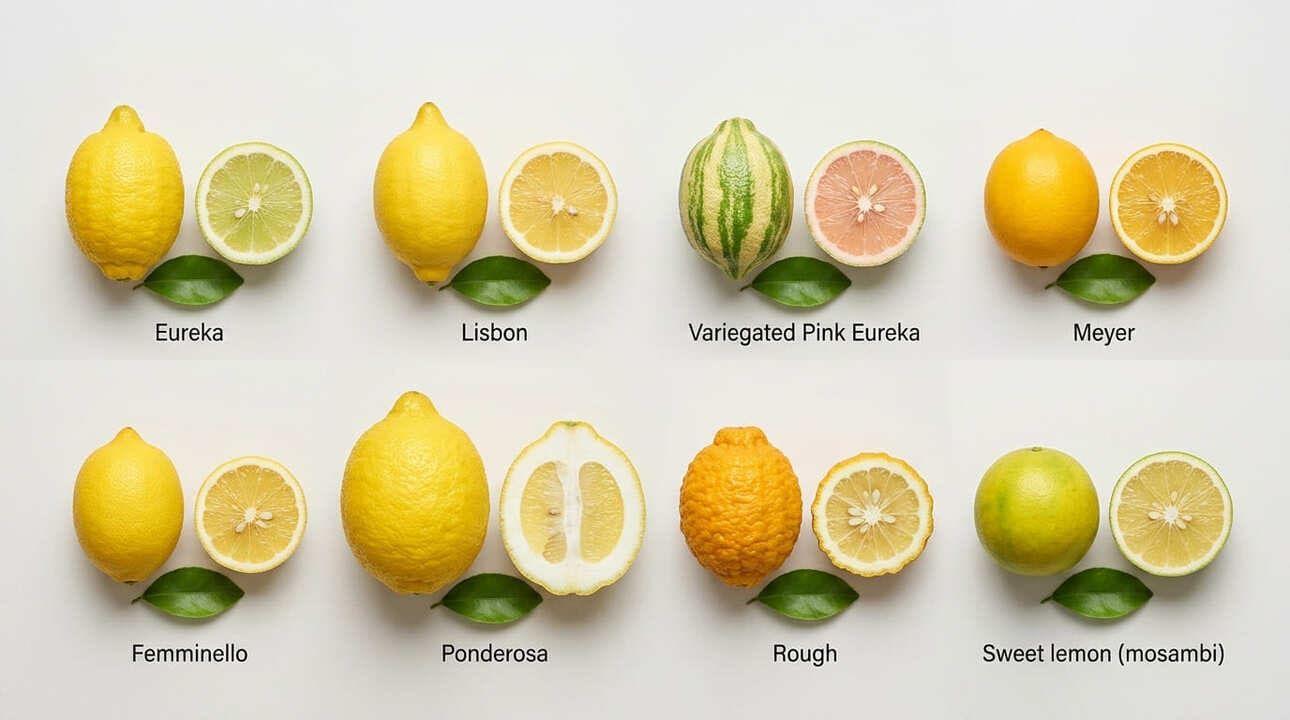
Use the chart to match the names of different types of lemons to their fruit and flavor. It covers all types of lemons in this guide, and harvest seasons are for California unless another country is named.
| Variety | Latin name | Group | Fruit | Flavor | Main season |
| Eureka | Citrus limon | True lemon | Ridged rind, short blunt tip | Very sour, few seeds | All year, peak late winter to early summer |
| Lisbon | Citrus limon | True lemon | Smoother rind, longer tip | Sour | Winter and early spring |
| Villafranca | Citrus limon | True lemon | Same as Eureka | Sour | Mainly winter |
| Variegated Pink Eureka | Citrus limon | Eureka sport | Green and cream stripes, pink flesh | Sour | Like Eureka |
| Femminello | Citrus limon | True lemon (Italy) | Oval | Sour | Several crops a year |
| Interdonato | Citrus limon | Lemon and citron hybrid (Italy) | Thornless tree, citron like leaves | Sour | September to October |
| Fino | Citrus limon | True lemon (Spain) | Export quality fruit | Sour | October to February |
| Verna | Citrus limon | True lemon (Spain) | Large | Sour | Late winter to summer |
| Meyer | Citrus × meyeri | Hybrid | Round, deep yellow with orange tint | Sweeter, less acidic | Mainly winter |
| Ponderosa | Citrus × pyriformis | Hybrid | Huge, thick bumpy rind | Sour like a lemon | All year |
| Rough lemon | Citrus jambhiri | Hybrid | Thick, warty rind | Sour, poor quality | Used as rootstock |
| Sweet lemon | Citrus limetta | Hybrid | Greenish, orange shaped | Almost no acid | Sold for juice in India |
Common Types of Lemons in the Grocery Store

Eureka and Lisbon are the two common types of lemons in US supermarkets, and the sticker rarely says which one you have. Eureka is farmed almost everywhere lemons grow, with Italy, Spain and a few other Mediterranean areas as the exceptions. Both are types of yellow lemons with sour, juicy flesh.
Eureka Lemon
Picture a lemon and you probably picture a Eureka (Citrus limon 'Eureka'). Its rind is ridged and a little rough, and the tip is small and blunt. Inside, the flesh is pale greenish yellow and very acidic, with few seeds.
Eureka trees have few thorns, and their new shoots and flowers are tinged purple. In coastal California the crop is spread through the whole year, with the heaviest harvest from late winter to early summer.
Lisbon Lemon
In a bag of lemons, Lisbon (Citrus limon 'Lisbon') is hard to tell from Eureka. On the tree the difference is easier to see. It is thornier, and its main crop comes in winter and early spring, with smaller crops later in the year. The fruit usually has a smoother rind and a more pronounced tip than Eureka.
UC Cooperative Extension in Ventura County rates Eureka as clearly more frost sensitive than Lisbon, so Lisbon is the better bet where winters get colder.
Villafranca Lemon
Villafranca is said to come from Sicily. Its fruit cannot be told from a Eureka, but most of the crop ripens in winter, as Lisbon's does.
Different Types of Lemons With Pictures for Home Gardens
Garden centers sell a few lemon types that rarely reach supermarkets. People often buy them for the look of the tree, so here are these types of lemons with pictures and names.
Variegated Pink Eureka Lemon
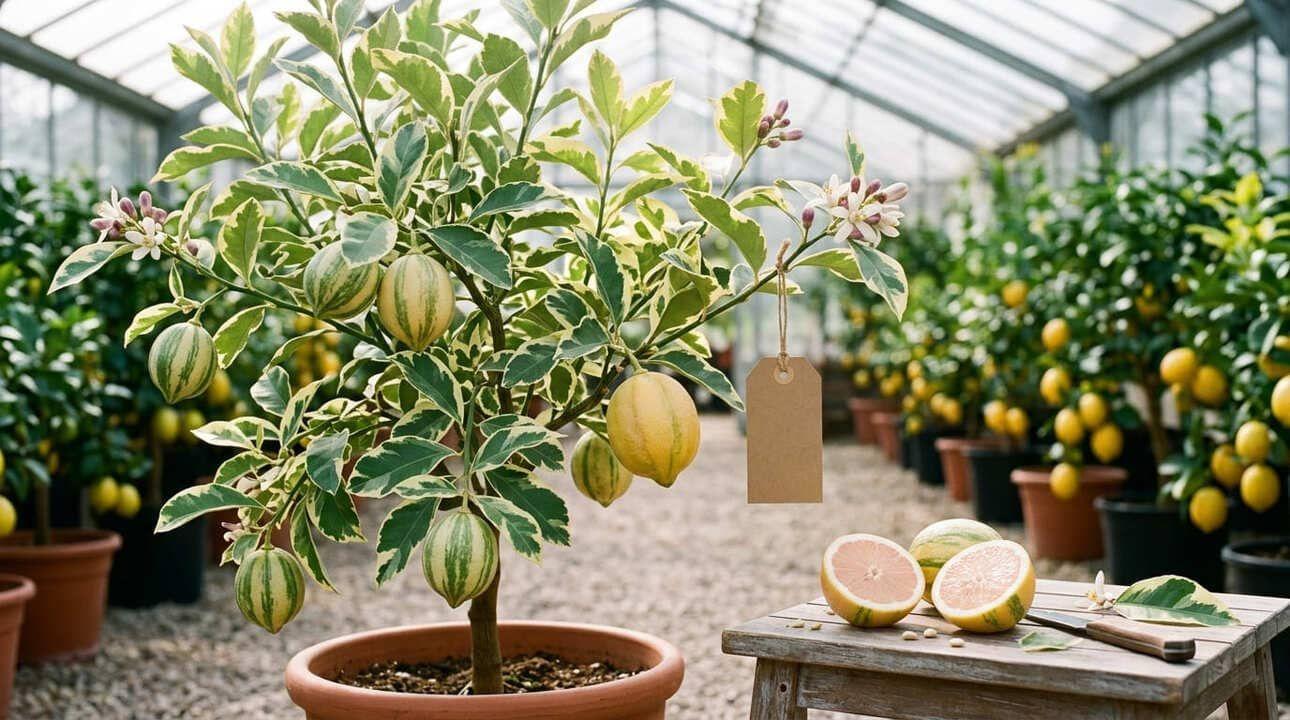
Variegated Pink Eureka lemon, often sold as Pink Lemonade, is a bud sport of Eureka. The leaves are splashed green and white, and young fruit carries green and cream stripes on the rind. Cut one open and the flesh is pink, colored by lycopene, the pigment in pink grapefruit.
The tree grows a little slower than a standard Eureka. Stripes fade as the fruit ripens, so pick a few lemons young if you want them striped.
Bearss Lemon
Bearss lemon (Citrus limon 'Bearss') was developed in Florida in the 1950s. UF/IFAS Extension calls it very juicy and possibly tarter than Lisbon, and its zest carries a lot of lemon oil. The tree grows fast and starts bearing earlier than most. Do not confuse it with Bearss lime, a Persian lime sold under the same name.
Harvey Lemon
Harvey is a Florida backyard lemon with the usual oval shape and tart juice. You will find almost no seeds in it.
Types of Italian Lemons
Most types of lemons in Italy belong to the Femminello group, which has historically made up about three quarters of the Italian harvest. Femminello trees flower almost all year, and Sicilian growers use that to force an extra summer crop called verdelli. The group has one weak spot, mal secco, a fungal disease caused by Plenodomus tracheiphilus. That is why Sicilian orchards also grow more tolerant lemons.
Femminello Lemon (Limone di Siracusa)
Femminello is the main lemon of Sicily. A label reading Limone di Siracusa IGP means Femminello or one of its clones, grown on the east coast of the island.
Amalfi Lemon (Sfusato Amalfitano)
Sfusato Amalfitano is the lemon of the Amalfi Coast, protected as Limone Costa d'Amalfi IGP. Sfusato means spindle in Italian and describes the long fruit with a tapered end. Under a thick white pith the pulp is nearly seedless, and the peel smells strongly of lemon oil. That peel is the base of limoncello and of local pastries such as limoncello baba.
Sorrento Lemon
Limone di Sorrento has its own IGP and grows on the Sorrento peninsula, next door to the Amalfi Coast. By variety it is a Femminello, not a Sfusato.
Monachello Lemon
Sicilian growers plant Monachello mostly because it resists mal secco better than Femminello does. Along with Femminello and Interdonato, it is one of the three lemons Sicily grows most.
Interdonato Lemon
Interdonato lemon is considered a lemon and citron hybrid. It appeared around 1875 on the land of a Colonel Interdonato in Nizza, Sicily. It is the earliest Italian lemon, ripening in September and October, and its trees are usually thornless. The fruit is sold as Limone Interdonato di Messina IGP.
Lemon Varieties From Spain

Verna and Fino are the main lemon varieties of Spain and cover roughly 90% of Spanish lemon orchards. Fino ripens first and supplies export markets from October to February.
Verna is a Spanish variety grown mostly in Alicante and Murcia. Its nearly thornless trees flower two or three times a year and carry large fruit. Verna comes in after Fino, which keeps Spanish lemons on the market for most of the year.
Types of Sweet Lemons and Large Lemon Hybrids
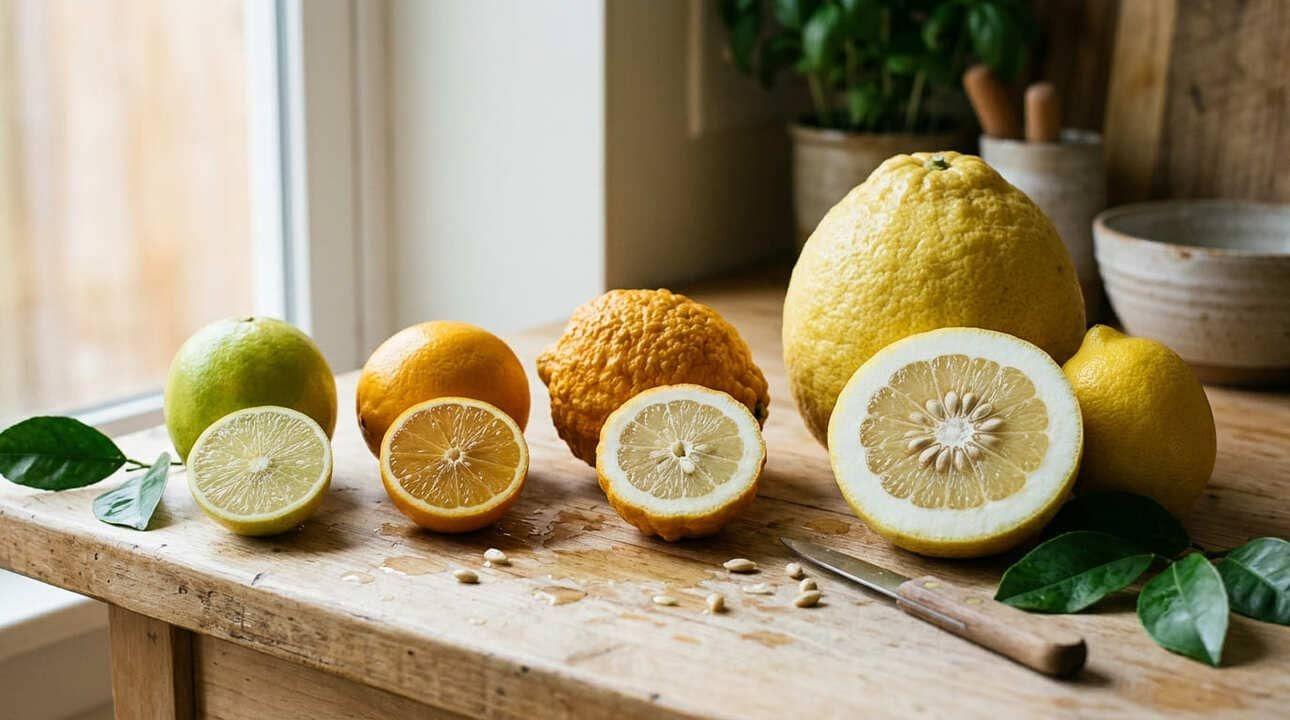
Some fruits sold as lemons have a second citrus parent. UF/IFAS Extension lists Ponderosa, Meyer, rough lemon and sweet lime among the lemons, though each one is its own hybrid. The other parent shows in the taste, the size of the fruit or the frost the tree can take.
Meyer Lemon
Meyer lemon (Citrus × meyeri) is the sweetest of the popular types of lemons and the easiest one to keep in a pot. USDA plant explorer Frank Meyer brought it from Beijing to the United States in 1908. Its exact parentage is still debated. UC Riverside calls it a lemon and orange hybrid, while UF/IFAS lists it as a cross of citron with a mandarin and pomelo hybrid.
The fruit is rounder than a Eureka, with a thin, deep yellow rind that takes on an orange tint when ripe. Its zest smells closer to bergamot than to a regular lemon. Trees reach 6 to 10 ft (2 to 3 m), and mature trees tolerate about 22°F (−5.6°C), according to UC Master Gardeners. Buy the Improved Meyer, which is free of the tristeza virus that the original trees carried.
Ponderosa Lemon
Ponderosa lemon (Citrus × pyriformis) is the largest of the common types of lemons. A single fruit often weighs around 2 lb (0.9 kg), and UF/IFAS notes it can reach grapefruit size. It began as a chance seedling grown by George Bowman in Hagerstown, Maryland, around 1887.
Ponderosa was long described as a lemon and citron cross, but a genomic analysis found only pomelo and citron DNA in it. The rind is thick and bumpy, yet the juice has the same acidity as a regular lemon. Trees are less cold hardy than true lemons and often flower and fruit at the same time.
Rough Lemon
Rough lemon (Citrus jambhiri) has a thick, warty rind and sour flesh. The 2018 Nature study confirmed that red rough lemon is a first generation cross of mandarin and citron. UC Riverside calls it a poor lemon substitute but an important rootstock in India, South Africa, Australia, Argentina, Brazil and Florida. When shoots grow from below the graft union of an old lemon tree, the fruit they bear is often rough lemon.
Sweet Lemon (Mosambi)
Sweet lemon (Citrus limetta) is an acidless citrus known in India as mosambi or mausambi. Despite the other common name, sweet lime, the fruit looks more like a greenish orange. In India it is sold mainly for fresh juice.
Types of Lemons by Region
Which lemon does well depends on the local winter and local diseases, so the types of lemons in California are not the ones that thrive in Florida or India. Among types of lemons in South Africa and Australia, Eureka is a safe starting point, since it is a major variety in most lemon growing countries. Growers in both countries have also long used rough lemon as a rootstock.
Types of Lemons Grown in California
California growers rely on Eureka in the coastal districts and on Lisbon, which has gained ground over Eureka in recent decades. Meyer is the classic backyard tree, and the Meyer lemon of the Central Coast is listed on the Slow Food Ark of Taste.
Types of Lemons in Florida
Different types of lemons in Florida home gardens include Bearss, Harvey, Lisbon, Meyer and Ponderosa. Meyer is the one UF/IFAS singles out as cold hardy enough to grow across the state, ripening from November to March. Citrus greening and citrus canker are the two diseases that can limit lemon growing in Florida yards, according to the UF/IFAS guide to lemon growing in Florida.
Types of Lemons in Arizona
Lisbon and Meyer are the safer types of lemons in Arizona yards, since both take cold better than Eureka. University of Arizona Extension advises planting citrus where cold air drains away, such as the slopes around Tucson.
Types of Lemons in India
Types of lemons in India include Assam lemon, called nemu tenga in Assamese, whose best known cultivars are Kaji Nemu and Gul Nemu. India also grows rough lemon, known as jambhiri, and the sweet lemon mosambi. Rough lemon is native to northeast India and in Assam is eaten as well as used for rootstock.
Types of Lemon Trees for Home Gardens
Choose among types of lemon trees by your winter low first, then by space. UC Master Gardeners in Sacramento put the damage point at 26°F (−3.3°C) for mature lemon trees and 22°F (−5.6°C) for Meyer. Young trees need frost cover for their first 4 or 5 years.
| Lemon tree | Cold tolerance | Good to know |
| Meyer | Best of the lemons, about 22°F (−5.6°C) | 6 to 10 ft tall, fruits in a pot |
| Lisbon | Hardier than Eureka | Thorny, main crop in winter |
| Eureka | About 26°F (−3.3°C) | Few thorns, crops all year near the coast |
| Variegated Pink Eureka | Like Eureka | Less vigorous, ornamental leaves |
| Bearss | Frost sensitive | Fast growing, bears young |
| Ponderosa | Less hardy than true lemons | Huge fruit, 12 to 24 ft in the ground |
How big lemon trees get depends mostly on root room. In a pot even a Ponderosa stays far below its 12 to 24 ft in the ground, and Meyer is compact to begin with. Our guide on how to grow a lemon tree covers soil and feeding. Potted citrus dries out fast, and a gardening app with care reminders keeps the watering on schedule.
Types of Lemons and Limes
Lemons and limes are different citrus fruits, though both have citron in their family tree. The 2018 Nature study showed that Mexican (Key) lime is a hybrid of Citrus micrantha and citron, while lemon comes from sour orange and citron. Limes are usually smaller and are sold green, while lemons are picked once they turn yellow.
Despite its name, sweet lime is classed with the sweet lemons.
How to Identify Different Types of Lemons on a Tree
Most types of lemons can be told apart on the tree itself. A ripe fruit and a mature branch are enough to sort all different types of lemons in a small orchard.
- Look at the tip of the fruit. A short, blunt tip points to Eureka, and a longer, sharper tip points to Lisbon.
- Feel the rind. Thick and bumpy suggests Ponderosa, warty suggests rough lemon, and green and cream stripes mean Variegated Pink Eureka.
- Check the branches for thorns. Lisbon trees are noticeably thornier than Eureka.
- Note the color of new leaves and flower buds. Purple tinged growth is typical of Eureka and Ponderosa.
- Taste a ripe fruit. A sweet, mild lemon with an orange tint is most likely Meyer.
On an old tree with no label, take a photo of the tree to narrow down the species first. Pale or spotted leaves point to a care or health problem rather than the variety, so scan the leaves for disease and see why lemon tree leaves turn yellow.
FAQ
What are the different types of lemons?
The different types of lemons fall into two groups. True lemons include Eureka, Lisbon, Villafranca, Femminello, Verna, Fino and Bearss. Lemon hybrids include Meyer, Ponderosa, rough lemon and sweet lemon. True lemons share one species, Citrus limon, while hybrids have another citrus parent that changes their flavor or size.
What is the most common type of lemon?
Eureka is the most common type of lemon worldwide and the one most US shoppers buy. UC Riverside lists it as a major variety in most lemon growing countries. Lisbon is a close second and is hard to tell apart in stores. Italy and Spain are the exceptions, growing mainly Femminello, Verna and Fino.
Is a Meyer lemon a real lemon?
No, a Meyer lemon is not a true lemon. Citrus × meyeri is a hybrid brought from Beijing in 1908, with parentage described as lemon and orange or citron and mandarin. It is sweeter and less acidic than Eureka or Lisbon, has a thinner rind and handles cold to about 22°F.
What are the sweetest types of lemons?
The sweetest types of lemons are sweet lemon (Citrus limetta), which has almost no acid, and Meyer lemon, which is noticeably less sour than store lemons. Among true lemons, Amalfi lemons from Italy are prized for a milder taste and fragrant peel. Eureka and Lisbon remain sharply acidic.
Is lemon a fruit?
Yes, lemon is a fruit. Botanically, a lemon is a hesperidium, a kind of berry with a leathery rind and juicy segments, the same fruit type as oranges and limes. It grows on Citrus limon, an evergreen tree in the rue family (Rutaceae).
Why are some lemons pink inside?
Some lemons are pink inside because they are Variegated Pink Eureka, a natural bud sport of the Eureka lemon. The flesh contains lycopene, the same pigment that colors pink grapefruit. The rind is striped green and cream when young, and the leaves are variegated, which makes the tree easy to recognize.