


Monstera Leaves Turning Yellow? How to Find the Cause and Fix It
Monstera leaves turning yellow are most often a sign of overwatering. Soggy potting mix cuts off oxygen to the roots, they start to rot, and the plant sheds its oldest leaves first. Underwatering, poor light, cold drafts, nitrogen shortage, pests and repotting stress explain most other cases. An old lower leaf yellowing now and then is just aging.
So before you change anything, look at which leaf went yellow and what the yellow looks like. If you'd rather start with a photo, a plant disease identifier will flag rot or leaf spot quickly. The table below teaches you to read the same signs by eye, and every cause after it comes with its own fix.
Don't guess, identify


Monstera Leaves Turning Yellow Causes, Sorted by Where the Yellow Shows Up
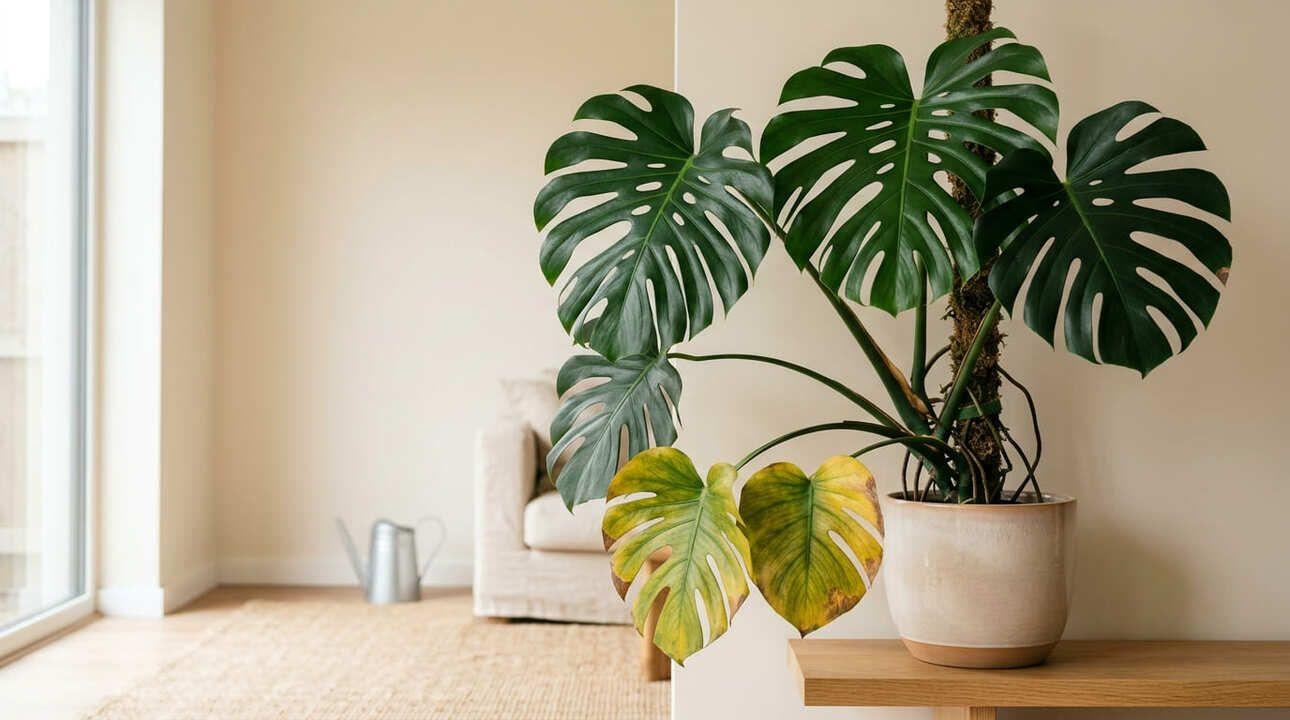
The position of the yellow leaf narrows the cause faster than anything else. Trouble at the bottom of the plant usually starts at the roots. Trouble on the newest leaf usually means cold or damage.
There's a simple reason for this. Nitrogen, phosphorus, potassium and magnesium can move around inside a plant. When they run short, the monstera strips them from its oldest leaves to feed new growth, and those old leaves fade. Iron and calcium can't be moved once they're placed, so a shortage of either shows up on young leaves instead.
| What you see | Most likely cause | Check first |
| One old bottom leaf evenly yellow, rest of the plant fine | Natural aging | Nothing, remove it once it browns |
| Several lower leaves yellow, mix still damp days after watering | Overwatering, root rot | Smell the pot, look at the roots |
| Yellow with soft brown or black patches, mushy stem base | Root rot or bacterial leaf spot | Roots and petiole bases |
| Yellow with crispy brown edges, mix pulling away from the pot | Underwatering | Moisture 2 inches down |
| Tips of monstera leaves turning yellow, then brown | Dry air, uneven watering, salt buildup | Humidity, white crust on the mix |
| Whole plant washed-out yellow-green, bleached patches near glass | Too much direct sun | Distance from the window |
| Lower leaves yellow, new leaves small and solid | Low light or nitrogen shortage | Light, date of last feeding |
| Fine yellow speckling, webbing, sticky residue | Spider mites, scale, mealybugs, thrips | Undersides of leaves |
| Newest leaf pale or yellow | Cold, root damage, iron shortage | Drafts, roots, old mix |
| Yellowing a few weeks after a new pot | Repotting stress or an oversized wet pot | Pot size, drying speed |
Why Are the Bottom Leaves of My Monstera Turning Yellow?
Monstera bottom leaves turning yellow are either normal aging or the first sign of wet roots, and you can tell which by counting. One leaf every few weeks is aging. Three or more going at once means something in the plant's care has changed.
Monstera Old Leaves Turning Yellow With Age
Monstera deliciosa, the Swiss cheese plant from the arum family (Araceae), holds each leaf for a long time, though not indefinitely. A plant putting out a new leaf at the top will often retire one at the base. Older monstera leaves turning yellow from age go an even, buttery color that creeps in from the margin, and the tissue stays firm with no spots.
If the new leaves still open at full size, there's nothing to fix. Snip the old one off when it's fully yellow or brown.
Monstera Lower Leaves Turning Yellow From Lack of Nitrogen
Nitrogen shortage looks like aging that doesn't stop. You get lower monstera leaves turning yellow one after another, new growth comes in paler, and the leaves get smaller with fewer splits. Iowa State University Extension explains that older leaves yellow first because the plant moves nitrogen into new growth when supply runs low.
I see bottom leaves of monstera turning yellow from hunger most often in plants that haven't been fed for months or that sit in old, broken-down mix. Penn State Extension suggests a balanced houseplant fertilizer every two weeks in the growing season and once a month in winter. Only feed a plant whose roots are healthy. On a rotting root ball, fertilizer just adds salt stress.
Monstera Leaves Turning Yellow From Overwatering and Root Rot
Overwatering is the most common cause of yellow monstera leaves, and by the time you see it the damage is already underground. Roots breathe. In mix that never dries, the fine root tips suffocate, rot organisms take over, and the plant loses its ability to pull up water. That's why the leaves yellow and often droop while the pot is still wet.
Signs that it's root rot and not something else:
- The mix is still damp 5 to 7 days after watering.
- The pot smells sour or swampy.
- Leaves "sweat" droplets along their edges, which the University of Wisconsin links to mix that's too wet.
- Petiole bases near the soil are dark and soft.
- Fungus gnats fly up when you water.
The same thing explains most monstera leaves turning yellow in winter. Light drops, the plant drinks far less, and a summer watering schedule keeps the mix wet for weeks.
What to Do When My Monstera Plant Leaves Are Turning Yellow From Rot
- Stop watering and ease the plant out of its pot.
- Rinse the root ball gently so you can actually see the roots.
- Cut every brown, hollow or mushy root back to firm white or tan tissue, using pruners wiped with alcohol.
- Remove leaves that are more than half yellow, so the damaged roots have less leaf to supply.
- Repot into fresh aroid mix (regular potting mix opened up with bark and perlite) in a pot with drainage holes, sized to the roots you have left.
- Water lightly once, then wait until the top 1 to 2 inches are dry.
- Keep the plant warm, in bright indirect light, while it regrows roots.
When more than half the roots are gone, take a stem cutting with a node as a backup. If you can't decide whether the roots are worth saving, PlantIn's botanists can look at a photo and tell you.
Why Are the Edges of My Monstera Leaves Turning Yellow?
Yellow edges with dry, papery brown rims usually mean the plant is short on water or humidity. Wet roots tend to yellow whole leaves. Dryness hits the margins first, because they sit farthest from the main veins.
In the wild, monstera grows in the understory of Central American rainforests. Penn State Extension puts its preferred humidity above 50%, and a heated apartment in January is often well below that. If you notice the edges of monstera leaves turning yellow along with limp stems, check the pot before blaming the air. Mix that dries out completely shrinks from the pot wall, and the next watering runs straight down the gap without soaking the roots. Monstera plant leaves turning yellow and brown at the margins, often curled, are the classic result.
To fix it:
- Stand the pot in a sink of water for 20 to 30 minutes so the dry mix can soak up water again.
- Let it drain and empty the saucer.
- Water whenever the top 1 to 2 inches feel dry, rather than on a set day.
- Add a humidifier if the room sits below about 40% humidity.
Why Are the Tips of My Monstera Leaves Turning Yellow?
Tips of monstera leaves turning yellow and brown while the rest of the leaf stays green come down to how evenly you water and what's in your water. Going from bone-dry to soaked and back stresses the tips first. Hard tap water and frequent feeding leave salts that show as a white crust on the mix or pot rim. Every few months, run plain water through the pot for about a minute to wash them out.
Monstera Leaves Turning Yellow With Brown Spots
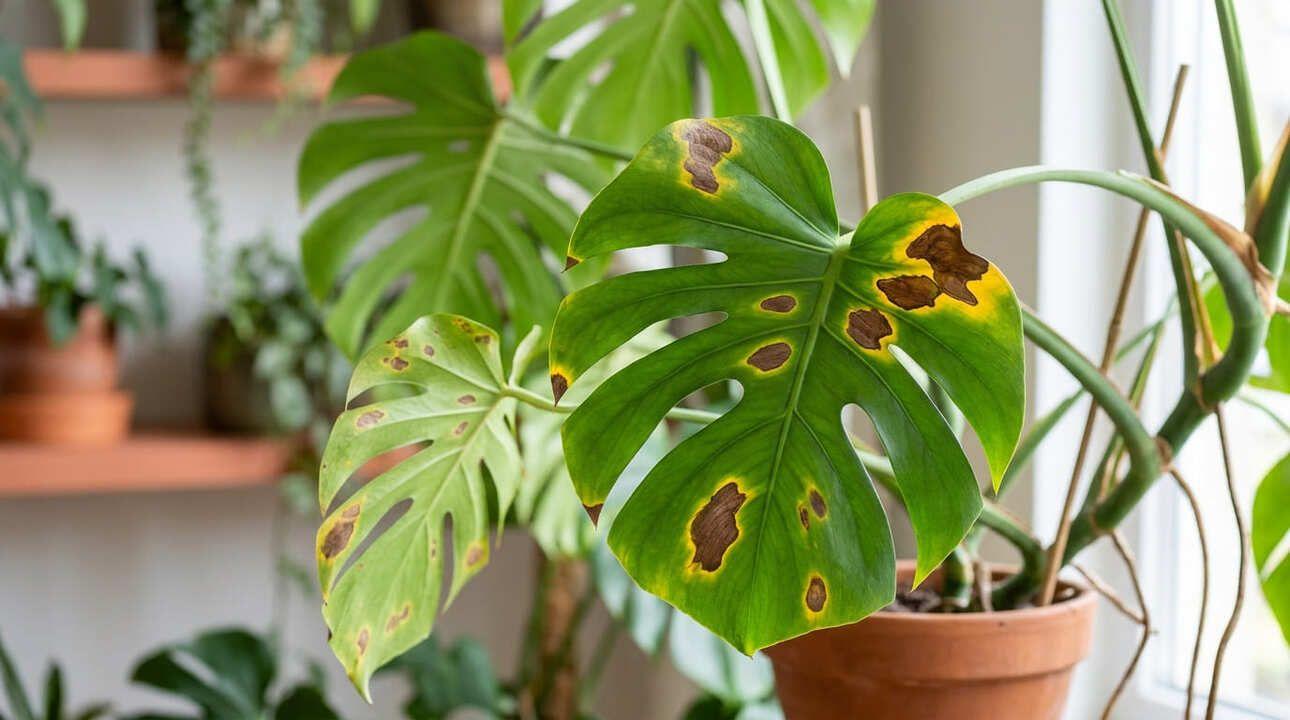
Brown spots with yellow around them are a separate problem, and the texture of the spot tells you more than its color.
- Soft, dark, water-soaked spots ringed in yellow are bacterial or fungal leaf spot. They show up on plants kept wet or on leaves that stay damp. Cut the worst leaves, water the soil and not the foliage, and give the plant more air.
- Dry, tan or bleached patches on the side facing the window are sunburn. The University of Wisconsin notes that monstera burns when it's moved into stronger light too fast, so shift it gradually over a week or two.
- Brown patches spreading out from the base of the leaf follow root rot, and the roots need treating before the leaves will stop.
Monstera leaves turning brown and yellow from the bottom of the plant upward point to the roots, so check those first.
Leaves Turning Yellow on Monstera Because of Pests
Insects that feed on sap leave fine yellow speckling, not solid patches. Penn State Extension lists scale, aphids, mealybugs, spider mites, thrips and fungus gnats as the ones to watch for. Spider mites spin faint webbing under the leaves. Scale looks like small brown bumps stuck along the veins and petioles, often with sticky honeydew around them.
A hand lens and the underside of a leaf will tell you most of what you need. For anything you can't name, an insect and pest identifier helps separate a mite colony from ordinary dust. Dab scale and mealybugs off with rubbing alcohol on a cotton swab, keep the plant away from others, and repeat every week for several weeks to catch the new hatch.
Monstera Plant Leaves Turning Yellow in Too Much or Too Little Light
Light can yellow a monstera from either side, and the two look different. Too little light takes the lower leaves one at a time. Too much sun washes the whole plant out to a pale yellow-green.
Penn State Extension describes the right spot as bright light without direct sun. In a dim corner, the plant can't keep all its leaves running, so it drops the oldest. New ones come in small and solid, without fenestrations (the holes and splits monstera is known for). Small leaves on monstera turning yellow at the base while the top leans hard toward the window is what low light looks like. On a young plant, the small heart-shaped juvenile leaves near the soil are the first to go.
A south or west window in summer does the opposite and bleaches the leaves. This is the one kind of yellowing that reverses. Pull the plant a few feet back or put a sheer curtain up, and within a few weeks the green deepens again.
Monstera Leaves Turning Yellow After Repotting
A leaf or two yellowing after a repot is normal. Repotting tears off fine root hairs, and the plant may let an older leaf go while it regrows them. Yellowing that keeps going for weeks is a different story, and the pot is usually to blame.
Repotted Monstera Leaves Turning Yellow Weeks Later
The problem I run into most is a pot that's too big. Move a monstera from a 6-inch pot into a 12-inch one and most of the new mix sits where no roots reach. That outer soil stays wet for weeks, and the plant ends up overwatered even if you water carefully.
| Repotting stress | Pot too big and wet | |
| Starts | Within days | Slowly, over 2 to 6 weeks |
| Leaves affected | The 1 or 2 oldest | Several lower leaves in a row |
| Soil | Dries at the usual pace | Still damp a week after watering |
| What happens next | New growth resumes | Yellowing continues until roots rot |
Go up one pot size at a time, roughly 2 inches wider. The same trap catches monstera leaves turning yellow after transplant from a nursery pot into a decorative pot without a hole: water pools at the bottom where you can't see it.
What New Monstera Leaves Turning Yellow Usually Mean
When the newest leaf yellows and the older ones stay green, aging isn't the answer. Check these three, in order.
- Cold. Penn State Extension gives 60 to 85°F as the preferred range, and the University of Wisconsin notes that monstera stops growing below 50°F. A leaf that unfurls next to a cold window, an outside door or an AC vent can come out pale and stay that way.
- Root damage. A plant with rotting roots can push out a new leaf from stored reserves and then fail to keep it supplied. If the older leaves look dull too, check the roots.
- Iron and other immobile nutrients. These can't be moved out of old leaves, so a shortage shows on new growth, usually as yellow between green veins. It's rare in fresh mix and more likely in old, compacted soil or with very alkaline water.
Don't confuse this with a brand-new leaf that unrolls soft and light green. That's normal, and it darkens over a week or two. Monstera baby leaves turning yellow instead of darker as they firm up are the ones to look into.
Monstera Adansonii Leaves Turning Yellow and Other Varieties
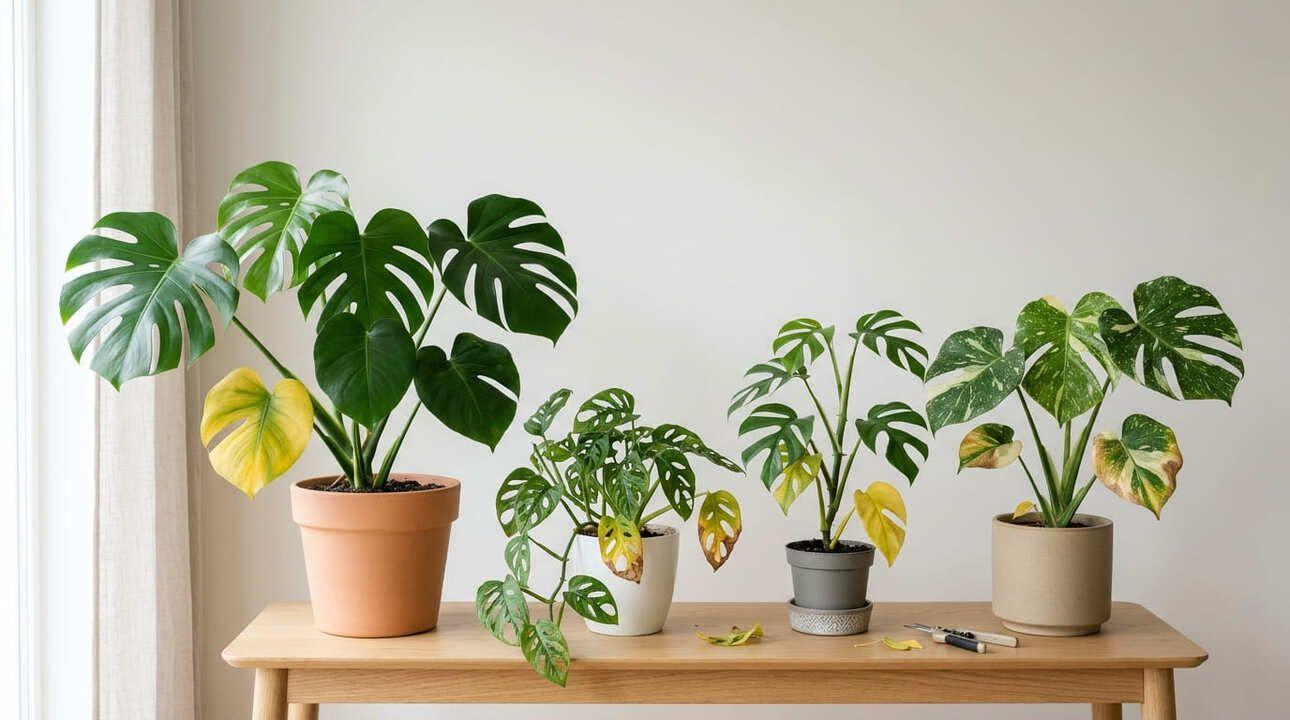
Every monstera yellows for the same basic reasons, but size and growth habit change which cause turns up most.
| Plant | Botanical name | Most common cause of yellowing |
| Swiss cheese monstera | Monstera deliciosa | Overwatering in big pots, low light |
| Swiss cheese vine | Monstera adansonii | Dry mix, dry air, hanging near heat |
| Mini monstera | Rhaphidophora tetrasperma | Overwatering, low light |
| Thai Constellation | Monstera deliciosa 'Thai Constellation' | Low light, cream sectors browning |
Swiss Cheese Monstera Leaves Turning Yellow on a Deliciosa
Monstera deliciosa leaves turning yellow follow everything above. What's specific to this species is its size. A big plant in a big pot holds a lot of water, so overwatering builds slowly and shows late. Water by feel, not by calendar. One more thing: the name "Swiss cheese plant" is also used for M. adansonii, so check which plant a care guide means before you follow it.
My Monstera Adansonii Leaves Are Turning Yellow
Monstera adansonii has thinner leaves and usually lives in a small pot or a hanging basket. NC State Extension describes it as a smaller, fast-growing plant. In practice its mix dries out faster, so monstera adansonii leaves turning yellow and brown at the edges point to dryness far more often than rot. Hanging baskets near the ceiling also sit in the warmest, driest air in the room, so check the soil more often than you would for a deliciosa.
Mini Monstera Leaves Turning Yellow
What's sold as mini monstera, or "monstera minima," is Rhaphidophora tetrasperma. It's a different genus in the same family, and NC State Extension lists it among the plants most often mistaken for M. deliciosa. Care is similar, but its smaller root system rots quickly in heavy, wet mix. That's why small monstera leaves turning yellow on a mini almost always lead back to a pot that stays wet. If you aren't sure which one you have, a houseplant identifier will confirm the species before you change anything.
Thai Constellation Monstera Leaves Turning Yellow
Variegated monsteras like 'Thai Constellation' and 'Albo' have cream sectors with little or no chlorophyll. NC State Extension notes that variegated cultivars need more light than plain green ones. In low light the green part of the leaf can't carry the rest, and lower leaves yellow sooner than on a plain deliciosa. Cream patches that go yellow and then crisp up are a weak point of these cultivars and not always a care mistake.
Propagated Monstera Leaves Turning Yellow in Water
A cutting in water has no roots yet, so its leaf keeps the stem alive from its own reserves, and it may yellow before roots arrive. That's the most common reason for monstera leaves turning yellow in water.
The University of Minnesota Extension points out that a monstera cutting only roots if it includes a node, the spot where a leaf and an aerial root meet the stem. A piece of leaf and petiole with no node can stay green for weeks and never root.
To give a cutting the best start:
- Take a section with at least one node and one or two leaves.
- Keep the node under water and the leaf and petiole above it.
- Change the water weekly. Stagnant water runs low on oxygen and starts to rot the stem.
- Keep the jar in bright indirect light at room temperature.
- Pot it up once the roots are a few inches long.
The yellowing usually stops once the first roots reach an inch or two. If the stem goes soft and brown at the waterline, cut above the rot and start again in fresh water. For the full method, including soil and air layering, see how to propagate monstera.
My Monstera Leaves Are Turning Yellow. Where Do I Start?
Start with the roots and water, because that's where most cases end. Then work outward through these checks.
- Count the yellow leaves. One old lower leaf is aging. Three or more at once is a care problem.
- Push a finger 2 inches into the mix. Still wet days after watering means too much water. Dry and pulling away from the pot means too little.
- Smell the pot and look at the stem base. A sour smell or soft, dark tissue means it's time to unpot and check the roots.
- Look at where the plant stands: distance from the window, direct sun, drafts and nearby heaters.
- Turn a few leaves over and look for webbing, bumps, speckles or sticky spots.
- Think back over the last six weeks. A repot, a move, a pot without drainage or a long gap between feedings often explains the rest.
- Cut off fully yellow leaves at the base of the petiole with clean, sharp pruners. Penn State Extension notes that every part of the plant is toxic if eaten and the sap can irritate skin, so wear gloves.
FAQ
Can yellow monstera leaves turn green again?
No, a monstera leaf that has turned fully yellow will not go green again. Its chlorophyll has broken down and the plant has already pulled most of the nitrogen out of it. The one exception is a whole plant gone pale yellow-green from strong sun, which darkens again within weeks in softer light.
Should I cut off yellow monstera leaves?
Yes, cut off monstera leaves once they are fully yellow or brown, at the base of the petiole, with clean pruners. A partly yellow leaf can stay until it fades, since it still photosynthesizes. Wear gloves: Penn State Extension notes the sap contains calcium oxalate crystals that can irritate skin.
Why is one of my monstera leaves turning yellow?
One monstera leaf turning yellow, usually the oldest one at the bottom, is most often natural aging. The plant lets an old leaf go as it grows new ones. If new growth looks healthy and the soil dries normally between waterings, nothing needs fixing. Several leaves at once point to watering or light.
Why are my monstera leaves turning yellow and drooping?
Monstera leaves turning yellow and drooping at the same time usually mean root rot from overwatering. Damaged roots can't move water up to the leaves, so the plant wilts even in wet soil. If the mix is bone-dry instead, the plant is underwatered. Check moisture 2 inches down before watering again.
Why are my monstera leaves turning yellow and brown?
Monstera leaves turning yellow and brown together point to either root rot or dryness, and the texture tells you which. Soft, dark patches spreading from the leaf base mean rot. Crispy brown edges with yellow behind them mean dry soil or dry air. Dry, bleached patches facing the window are sunburn.
Why do monstera leaves keep turning yellow in winter?
Monstera leaves often keep turning yellow in winter because the plant uses much less water in low light while the watering schedule stays the same. The mix stays wet longer and the roots start to rot. Water only when the top 1 to 2 inches are dry, and keep the plant above 60°F, away from cold glass.


