Types of Bushes and Shrubs: Flowering, Evergreen, Berry and Hedge Plants
The main types of bushes are flowering shrubs (hydrangea, lilac, rose), evergreen shrubs (boxwood, holly, juniper, arborvitae), berry bushes (blueberry, winterberry) and hedge or privacy shrubs (cherry laurel, arborvitae). They differ in leaf retention, mature height, hardiness zone and light needs, which decide where each one grows well.
We compared 21 shrubs that grow in most yards by how tall they really get, which zones they survive and how much sun they need. For each one you’ll also find when to prune it so it still flowers, and which popular bushes are invasive or toxic to pets. Already have a shrub you can’t name? A photo in our shrub identifier will tell you what it is, and that changes how you prune it.
Don't guess, identify


What Are the Different Types of Bushes? Shrub vs Bush
Bushes are grouped by three traits: whether they keep leaves in winter, what they are grown for and how big they get. In everyday American English, "bush" and "shrub" name the same plants.
A shrub is a woody perennial with several stems rising from near the soil line. UF/IFAS Extension quotes Cornell's definition of a tree as a woody plant with one central stem, generally over 12 feet tall. "Bush" is the casual word, often used for a low, dense shrub nobody has shaped. So lists of types of bushes and shrubs, or types of shrubs and bushes, describe one group under two names.
Some plants sit on the border. Panicle hydrangea can be trained onto a single trunk, and American arborvitae is sold for hedges even though the wild species reaches 40 to 60 feet.
Common Types of Bushes at a Glance
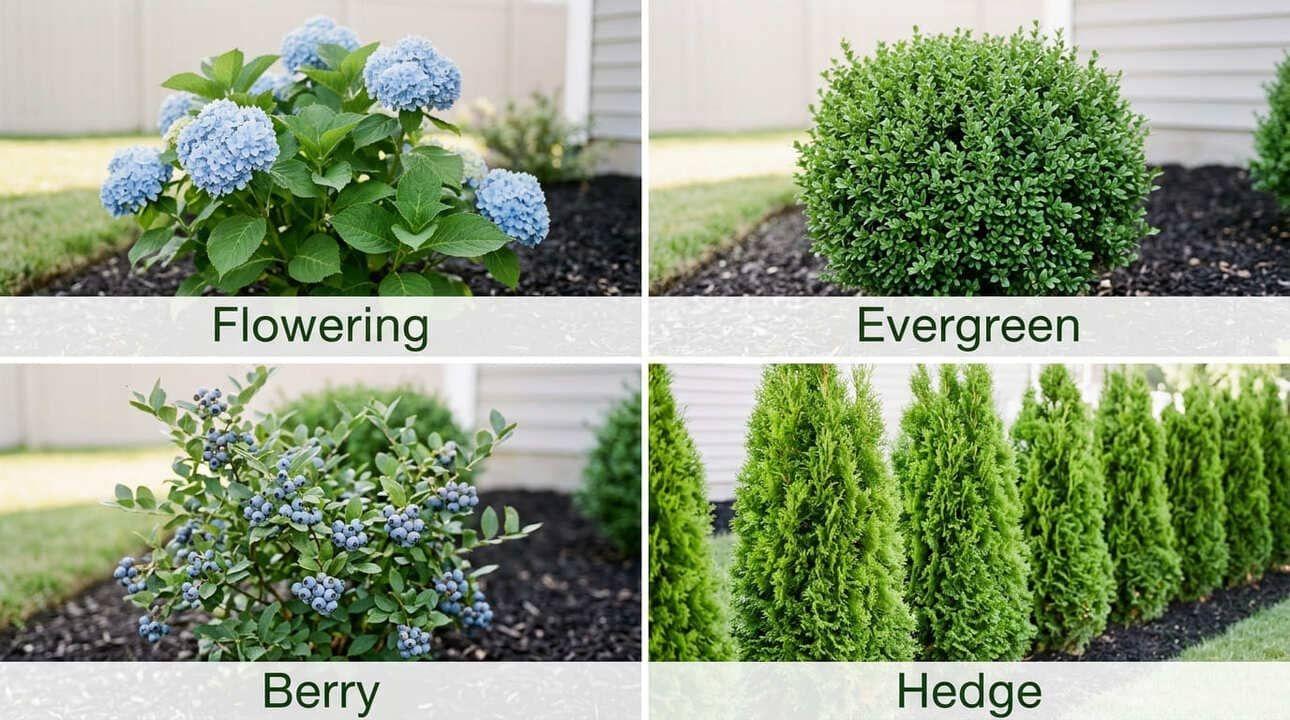
Sixteen of the most common types of bushes in North American yards are compared here by size, zone and light. Treat heights as typical, since cultivar and pruning shift them a lot.
| Bush | Latin name | Leaves | Mature height | USDA zones | Light | Best use |
| Bigleaf hydrangea | Hydrangea macrophylla | Deciduous | 3–6 ft | 6–11 | Part shade, no afternoon sun | Shade beds, foundation |
| Panicle hydrangea | Hydrangea paniculata | Deciduous | 8–15 ft | 3–8 | Sun to part shade | Specimen, back of border |
| Smooth hydrangea | Hydrangea arborescens | Deciduous | 3–5 ft | 3–9 | Part shade | Woodland edge |
| Oakleaf hydrangea | Hydrangea quercifolia | Deciduous | 4–8 ft | 5–9 | Sun to part shade | Fall color, natives |
| Common lilac | Syringa vulgaris | Deciduous | 8–16 ft | 3–7 | Sun to part shade | Fragrant screen |
| European snowball | Viburnum opulus 'Roseum' | Deciduous | 10–12 ft | 3–8 | Sun to part shade | Spring show |
| Azaleas and rhododendrons | Rhododendron spp. | Both | 6–10 ft | 4–8 | Dappled shade | Acidic shade beds |
| Gardenia | Gardenia jasminoides | Evergreen | 4–8 ft | 7b–11 | Part shade | Fragrance near patios |
| English lavender | Lavandula angustifolia | Evergreen | 1–2 ft | 5–9 | Full sun | Dry, sunny edging |
| Common boxwood | Buxus sempervirens | Evergreen | 5–20 ft | 5–8 | Sun to part shade | Low hedges, topiary |
| Japanese holly | Ilex crenata | Evergreen | 5–10 ft | 5–8 | Sun to part shade | Boxwood look-alike |
| Winterberry | Ilex verticillata | Deciduous | 3–15 ft | 3–9 | Sun to shade | Winter berries |
| Chinese juniper | Juniperus chinensis | Evergreen | 1–20 ft by cultivar | 4–9 | Full sun | Groundcover to screen |
| American arborvitae | Thuja occidentalis | Evergreen | Species 40–60 ft | 3–7 | Sun to part shade | Privacy rows |
| Cherry laurel | Prunus laurocerasus | Evergreen | 10–20 ft | 6–8 | Sun to deep shade | Tall hedge |
| Highbush blueberry | Vaccinium corymbosum | Deciduous | 6–12 ft | 3–8 | Sun to part shade | Fruit, fall color |
Which Types of Flowering Bushes Bloom on Old Wood or New Wood?
Lilac, bigleaf hydrangea, azalea and snowball viburnum bloom on old wood, while panicle hydrangea, smooth hydrangea and butterfly bush bloom on new wood. That split decides when you can prune without cutting off next season's flowers, so each plant below notes which group it falls in.
Among types of bushes with flowers, hydrangeas and roses have the widest choice, and they take up most of this section. The other types of flower bushes follow by genus.
Hydrangea Bushes and How the Four Types Differ
Gardeners mostly grow four types of hydrangea bushes. Bigleaf hydrangea (Hydrangea macrophylla) flowers on last year's stems, and its color follows soil pH: blue in acidic soil, pink in alkaline. Reblooming cultivars add a later flush on new growth.
Panicle hydrangea (H. paniculata) blooms from summer into fall on new wood. It takes more sun than the rest and survives zone 3 winters. Smooth hydrangea (H. arborescens), native to the eastern US, also blooms on new wood and can be cut almost to the ground in late winter. Oakleaf hydrangea (H. quercifolia) comes from the Southeast and earns its place in fall, when the lobed leaves go wine-red and mahogany.
When a bigleaf hydrangea leafs out well but never flowers, look at last spring's pruning first. A hard cut in March removes the buds the plant set the summer before.
Rose Bushes by Class
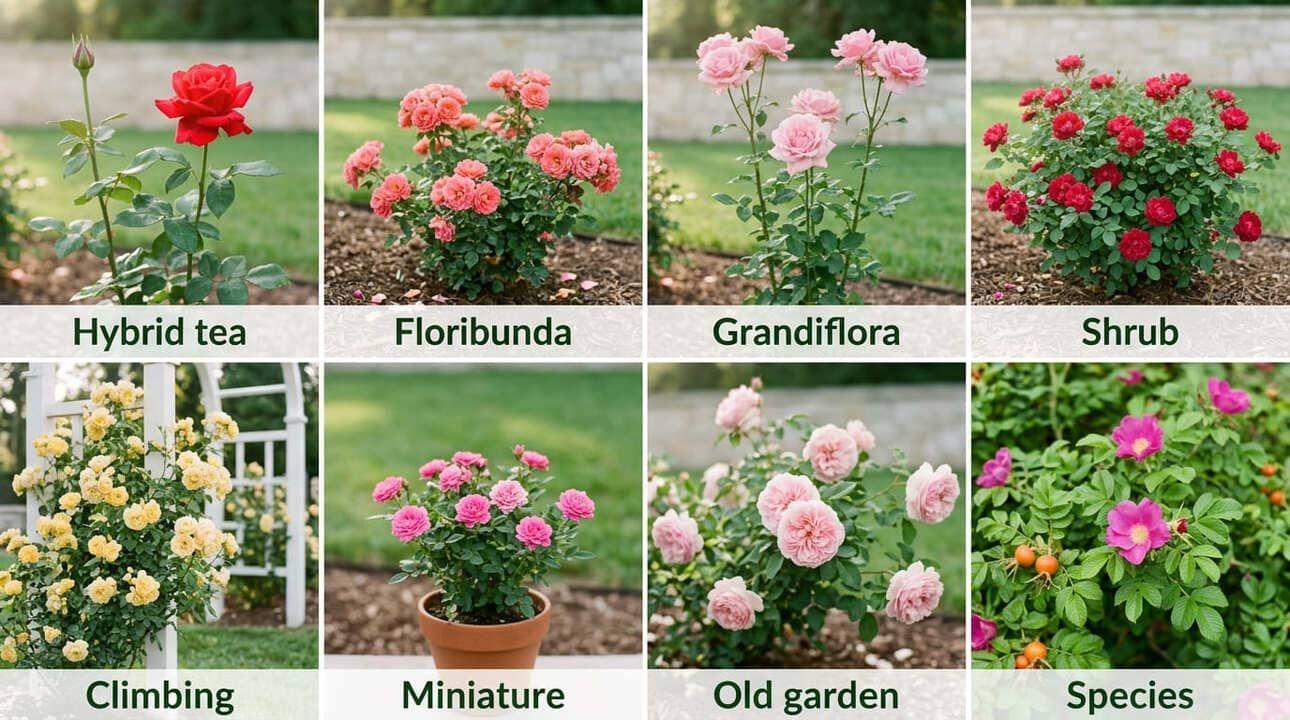
University of Illinois Extension sorts types of rose bushes into eight classes. Knowing the class tells you more about the care a rose needs than its color does.
| Rose class | How to recognize it | Typical size |
| Hybrid tea | One long, pointed bud per long stem | 3–5 ft |
| Floribunda | Flowers in clusters on a compact plant | 2–3 ft |
| Grandiflora | Hybrid tea-size flowers in clusters on tall stems | Tall, back of border |
| Shrub and landscape | Rounded plant, hardy, better disease resistance | Often over 4 ft |
| Climbing | Long canes trained on supports | 8–25 ft |
| Miniature | Small plant and flowers, constant bloom | 3–18 in |
| Old garden | Very fragrant, cold-hardy, many bloom once | 3–10 ft by group |
| Species (wild) | Simple flowers, colorful hips | Groundcover to 10 ft |
To identify types of rose bushes already in your garden, start with how the flowers are carried, one per stem or in sprays. Then look at the habit: upright, rounded or climbing. Pinning down a named cultivar is harder. A sharp photo of an open flower plus a leaf in a flower identifier usually gets you closer than paging through catalogs, and PlantIn adds care notes for the match.
Lilac Bushes

Common lilac (Syringa vulgaris) grows 8 to 16 feet tall and is hardy in zones 3 through 7. It flowers best after a cold winter, which is why it sulks in the Deep South. Korean lilac (Syringa oblata) and Persian lilac (Syringa × persica) round out the types of lilac bushes most nurseries carry. Next year's buds form in summer, so prune within a few weeks after the spring flowers fade.
Butterfly Bush
Most types of butterfly bushes on sale are cultivars of one species, Buddleja davidii. It reaches 6 to 12 feet in full sun and flowers from about June to September. Adult butterflies use the nectar, though native caterpillars can't feed on the leaves. One flower panicle can release up to 40,000 windblown seeds, NC State Extension notes, and the species is a listed noxious weed in Oregon and Washington. Check your state list before planting one.
Snowball Bushes

The types of snowball bushes are viburnums with round white flower heads. European snowball (Viburnum opulus 'Roseum') grows 10 to 12 feet tall and blooms in May. Its flowers are sterile, so you get no berries. Japanese snowball (V. plicatum) and Chinese snowball (V. macrocephalum) are sold under the same common name. People often mistake these for smooth hydrangea, and bloom time settles it. The viburnum flowers in spring, the hydrangea from late spring through summer.
Spirea Bushes
Japanese spirea (Spiraea japonica) is the one most yards have among the types of spirea bushes. It forms a deciduous mound 4 to 6 feet tall with pink clusters in June and July. NC State Extension lists it as invasive in several southeastern states, where it self-seeds and suckers into thickets. In the East, native meadowsweet (Spiraea alba) is the safer pick.
Azalea Bushes and Rhododendrons
Azaleas and rhododendrons share the genus Rhododendron, and the types of azalea bushes include evergreen and deciduous kinds. Azaleas usually flower around April, with funnel-shaped blooms and 5 stamens. Rhododendrons come later, with bell-shaped clusters, 10 stamens and thick, leathery leaves. Both want acidic soil below pH 6.0 that drains well. In heavy clay, roots rot, and the plant wilts even when the soil is wet.
Gardenia Bushes
Gardenia (Gardenia jasminoides), sold as cape jasmine, is an evergreen 4 to 8 feet tall and hardy only in zones 7b through 11. Most types of gardenia bushes differ in size, and creeping forms such as 'Radicans' stay low enough for edging. The soil needs to stay below pH 6.0. Yellowing leaves with green veins usually mean the soil has drifted alkaline and the roots can no longer take up iron.
Lavender Bushes

English lavender (Lavandula angustifolia) is a woody subshrub just 1 to 2 feet tall, evergreen and gray-green, hardy in zones 5 through 9. Of the types of lavender bushes in garden centers, this one and lavandin (Lavandula × intermedia) are the two you'll see most. Wet roots kill far more lavender than cold does. Plant it in full sun, in gravelly or raised soil that drains within minutes of rain.
Evergreen Choices: Types of Evergreen Bushes and Shrubs
Evergreen shrubs hold their leaves or needles year-round and give a yard its shape in winter. Broadleaf types of evergreen bushes include boxwood, holly and laurel, and the needled ones are juniper and arborvitae.
Boxwood Bushes

Common boxwood (Buxus sempervirens) can reach 5 to 20 feet in zones 5 through 8, yet it handles shearing so well that many hedges stay knee-high for decades. The types of boxwood bushes differ mostly in speed and leaf size. 'Suffruticosa', called English boxwood, is the classic low edging form, and littleleaf box (Buxus microphylla) has smaller leaves. Deer and rabbits tend to skip it. The leaves contain steroidal alkaloids that are toxic to cats, dogs and horses.
Holly Bushes

Holly comes in evergreen and deciduous forms, and only females carry berries. Among the different types of holly bushes, two cover most yard uses.
Japanese holly (Ilex crenata) stays evergreen and grows 5 to 10 feet, while many cultivars top out at 3 to 4 feet. Small leaves and black berries make it a common stand-in for boxwood.
Winterberry (Ilex verticillata) drops its leaves in fall and keeps red berries well into winter. It grows 3 to 15 feet tall in zones 3 through 9 and copes with wet soil. NC State Extension advises one male for every 10 to 20 females, planted within 50 feet. A holly that flowers every spring and never fruits is usually missing that male. The berries contain saponins and can cause vomiting if eaten.
Juniper Bushes
Chinese juniper (Juniperus chinensis) is a needled evergreen for full sun in zones 4 through 9. Its cultivars run from groundcover to column, and the types of juniper bushes span 1 to 2 feet (var. sargentii) to 15 to 20 feet ('Spartan'). In shade the needles thin out, so give junipers at least 6 hours of direct sun.
Arborvitae Bushes

American arborvitae (Thuja occidentalis) is a native conifer for zones 3 through 7, planted for hedges and windbreaks. The wild species reaches 40 to 60 feet, so the types of arborvitae bushes that suit home yards are compact or narrow cultivars such as 'Hetz Midget' and 'DeGroot's Spire'. Expect trouble in full shade, where foliage thins, and in winter, when deer browse it hard.
Laurel Bushes
Cherry laurel (Prunus laurocerasus), also sold as English laurel, leads the types of laurel bushes used for hedges. It grows 10 to 20 feet tall in zones 6 through 8 and stays glossy from full sun to deep shade. 'Otto Luyken' and 'Schipkaensis' (skip laurel) are lower cultivars. NC State Extension rates its toxicity as high, because leaves, stems and seeds contain cyanogenic glycosides. Keep clippings away from pets and livestock.
Growing Types of Berry Bushes for Fruit and Birds
Berry bushes are shrubs grown for fruit people eat or fruit that feeds birds. In a home garden the two main types of berry bushes are highbush blueberry for harvest and winterberry holly for winter color.
Blueberry Bushes
Highbush blueberry (Vaccinium corymbosum) grows 6 to 12 feet tall in zones 3 through 8. It needs soil below pH 6.0, ideally close to 5.0. Highbush is the northern choice among types of blueberry bushes, and rabbiteye types suit hot southern summers. In alkaline soil, new leaves yellow between green veins (interveinal chlorosis), a sign the roots can't absorb iron. Test pH before you plant, since lowering it later takes a season or more.
How to Choose Types of Bushes for Landscaping
Choose types of bushes for landscaping by mature size, light and zone first, and by looks after that. Most shrub problems in yards start with a 12-foot plant set where a 4-foot one belonged.
Bushes for the Front of the House and Front Yard
Types of bushes for front of house beds and front yard foundations should stay below the windowsill when grown and look decent in winter. A simple way to plan the bed:
- Measure from the wall to the path, and from the ground to the bottom of the windows.
- Note your USDA zone and how many hours of direct sun the bed gets.
- Set the evergreen frame first with Japanese holly cultivars, dwarf boxwood or low junipers.
- Add one or two flowering shrubs in front, such as smooth hydrangea in shade or lavender in sun.
- Plant each shrub at least half its mature width away from the wall so air can move behind it.
Hedge and Privacy Bushes
For a formal low hedge, boxwood and Japanese holly are the standard types of hedge bushes. Tall types of privacy bushes come down to arborvitae in cold zones 3 to 7 and cherry laurel in milder zones 6 to 8 or in shade. A privacy row needs evergreen growth all the way to the ground, so deciduous shrubs like lilac only screen in summer.
Types of Thorn Bushes and Shrubs to Plant With Care
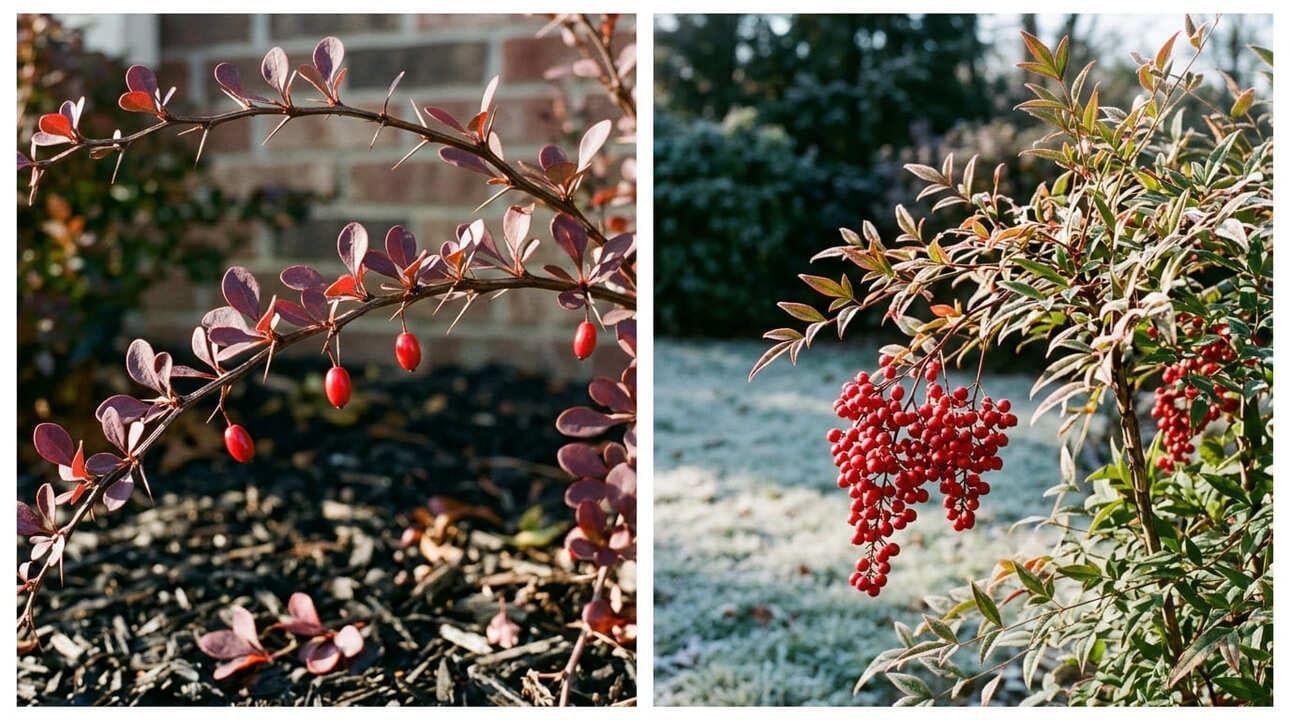
A few shrubs still sold everywhere spread into wild land or are toxic. These types of thorn bushes and invasive plants deserve a second look before you buy.
Barberry Bushes
Japanese barberry (Berberis thunbergii) is a thorny deciduous shrub 3 to 6 feet tall, with one spine at each node. Most types of barberry bushes on sale, red, gold or dwarf, are cultivars of this invasive species. It spreads through root suckers and seed dropped by birds. Breeders now sell low-seed cultivars, and whether your state allows them is worth checking first.
Nandina Bushes
Nandina (Nandina domestica), or heavenly bamboo, is an evergreen 3 to 8 feet tall with red berries in winter. All types of nandina bushes contain cyanogenic glycosides. NC State Extension reports the berries are highly toxic to birds, citing a Georgia study that linked them to cedar waxwing deaths, and lists the plant as toxic to cats, dogs and horses. North Carolina also lists it as invasive. If you keep one, cut off the berry clusters in late fall. If a pet chews any of these shrubs, call your veterinarian or a pet poison hotline.
How to Trim Different Types of Bushes
How to trim different types of bushes comes down to bloom time. Prune spring bloomers right after they flower, and prune summer bloomers in late winter, because spring flowers grow from buds set the year before.
- Identify the shrub and note the month it blooms.
- Prune old-wood bloomers (lilac, bigleaf hydrangea, azalea, snowball viburnum) within a few weeks after flowering.
- Prune new-wood bloomers (panicle and smooth hydrangea, butterfly bush) in late winter, before buds open.
- Shape evergreens such as boxwood, holly and juniper lightly in late spring, and stop by late summer so new growth can harden before frost.
- Take out no more than about a third of the stems on an established shrub in one year.
- Cut back to a bud, a side branch or the base, without leaving stubs.
The most common pruning mistake is shearing a hydrangea or lilac in early spring. A dated reminder in a gardening app prevents it.
FAQ
What are the most common types of bushes?
The most common types of bushes in US yards are hydrangeas, roses, boxwood, hollies, azaleas, junipers, arborvitae and lilacs. Garden centers stock them almost everywhere, they cover zones 3 through 9 between them, and they fill the main roles in a landscape: flowers, evergreen structure and privacy.
What are 10 examples of shrubs?
Ten examples of shrubs are bigleaf hydrangea, common lilac, rose, azalea, gardenia, boxwood, Japanese holly, Chinese juniper, highbush blueberry and cherry laurel. Each is a woody perennial with several stems from the base, which separates a shrub from a tree with a single trunk.
How do I identify my bush?
Identify a bush by leaf arrangement (opposite or alternate), leaf shape, whether it keeps leaves in winter, and its flowers or berries. Photograph a leaf, a stem and any flowers, then compare them in a plant identification app or bring a sample to your local extension office.
What are the different types of rose bushes?
The different types of rose bushes are hybrid tea, floribunda, grandiflora, shrub, climbing, miniature, old garden and species roses. Floribundas and shrub roses are easiest for beginners, because they are bred for compact growth, clustered flowers and better disease resistance than most hybrid teas.
What are the different types of hydrangea bushes?
The different types of hydrangea bushes in gardens are bigleaf, panicle, smooth and oakleaf hydrangea. Bigleaf and oakleaf flower on last year's stems. Panicle and smooth flower on new growth, so those two can be cut back hard in late winter without losing that summer's blooms.
What are good types of landscaping bushes for beginners?
Good types of landscaping bushes for beginners are panicle hydrangea, smooth hydrangea, Japanese holly and Chinese juniper cultivars. They forgive pruning mistakes, grow across many zones and have few serious pests. Match each one to the hours of sun in your bed before planting.